
Will AI Agents Become Finance’s New Interface? OKX’s Lennix Explains
 Curtis Moore
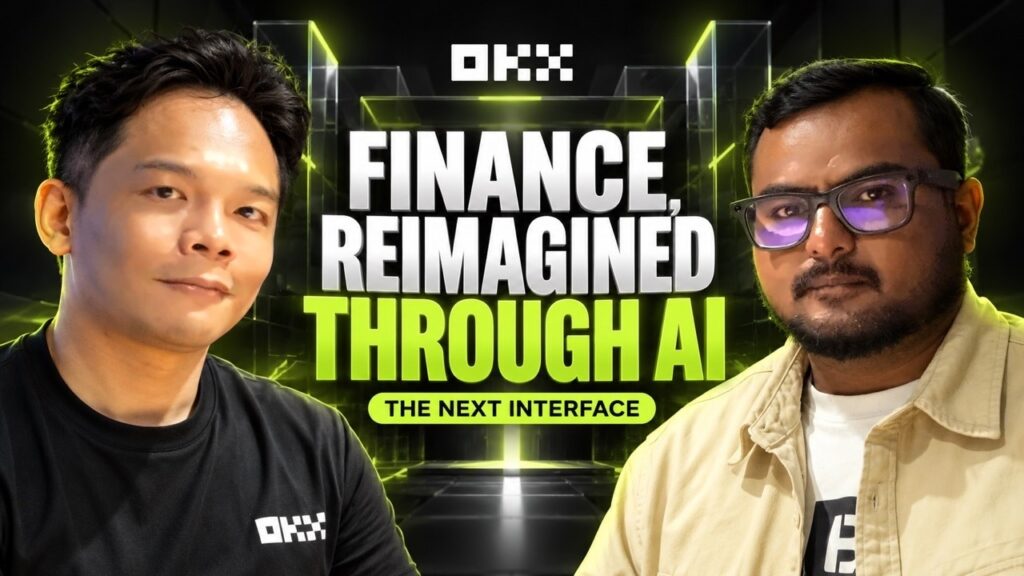
For more than a decade, crypto exchanges have competed on the screen. Faster apps, cleaner charts, fewer taps to place a trade. According to one of OKX’s longest-serving executives, that contest is about to change. The next big user of a crypto exchange may not be a person at all – it may be a fleet of AI agents acting on that person’s behalf.
On the sidelines of Token2049 in Singapore, Mohammad Ahmad Khan, co-founder of The Blockopedia, sat down with Lennix Lai of OKX for the TBP Podcast. Lennix joined OKX in 2017 after a career in traditional finance. Over 18 minutes, the conversation covered why he left Wall Street for a young exchange, why AI agents in crypto trading are now an infrastructure priority, how exchanges are turning into financial super apps, and why so many crypto exchanges did not survive the last bear market.
Key Takeaways
- OKX believes AI will become the next trading interface. Users may stop clicking through apps and instead direct agents that trade, pay and manage wealth for them.
- Being “agent ready” means more than an API. It needs secure servers, permission rules for what an agent can and cannot do, updated compliance standards and the capacity to handle agent-scale traffic.
- Lennix does not call OKX an operating system for crypto. He calls it an “agentic layer” that lets ordinary users talk to financial products in plain language.
- Within five years, he expects crypto exchanges to become financial super apps that hold equities, forex, commodities, rates products and crypto in one margin account, trading 24/7.
- Exchanges that depended only on crypto trading volume were wiped out in bear markets. Survivors widened into traditional finance products, banking partnerships and audits.
- His advice to newcomers to this cycle: the stories are stablecoins and real-world assets (RWA), so study the companies building them, not only the tokens.
From Wall Street to a young crypto exchange
Lennix joined OKX in 2017, more than eight years ago. At about the same time, he read the Bitcoin white paper for the first time. He admits that before that, he thought Bitcoin was a scam. The paper changed his mind. It is only a few pages long, and he was struck by how simple the mathematics behind it was.
He came from a traditional banking and trading background, with past roles at JP Morgan and AIG. Those firms were sophisticated and ran huge operations. OKX, by contrast, was very young. His first job there was to bring traditional financial products into crypto.
The reason was volatility. Bitcoin’s annualised volatility at the time ran above 100%. Lai’s view was that more financial instruments and derivative products would help smooth the market, improve liquidity and give traders better tools for managing risk.
Why you cannot copy traditional finance one-to-one
The early plan was to take what worked in traditional markets – funds, ETFs, index products – and rebuild them for crypto. It did not work. Crypto, Lennix says, is a very different market, and you cannot replicate traditional finance 100% in one go.
His example is collateral. Eight years ago, USDT was not yet the default stablecoin for trading. If you wanted to trade a Bitcoin derivative, the only thing you could deposit was crypto itself, usually Bitcoin or Ethereum. That meant traders were buying Bitcoin derivatives with Bitcoin as margin. The profit-and-loss curve of such a position is not linear, so OKX had to make many adjustments in its back end.
The textbook concepts stayed the same. The details changed. Lennix calls those small adjustments innovation: tailoring proven instruments to the special conditions of the crypto market.
OKX in one line: the glue between two worlds
Asked to describe OKX in a single line, Lennix answers that it sits in the transaction between traditional finance and crypto finance. “We are the glue of these two worlds,” he says, describing OKX as a global fintech powerhouse.
That positioning has hard numbers behind it. In March 2026, Intercontinental Exchange (ICE), the parent company of the New York Stock Exchange, took a stake in OKX at a $25 billion valuation and a seat on its board, with plans to give OKX’s roughly 120 million users access to ICE’s U.S. futures markets and tokenized NYSE-linked equities.
Why a crypto exchange cares about AI agents
This is the core of the interview, and the reason the episode is titled “Will AI Become Finance’s New Interface?”
Lennix says OKX believes AI is likely to become the next-generation trading interface – the way people interact with the whole financial ecosystem. Until now, fintech companies, banks, neobanks, crypto exchanges and wallets have spent huge effort on UI and UX. Every product was built to serve a human.
Once AI becomes powerful enough, and intelligence becomes scalable and cheap, that changes. People may no longer interact directly with an exchange’s products. Instead, they will use a fleet of agents, each acting like a specialist, that interact with the exchange for them.
So OKX is planning for a new kind of customer base. It serves tens of millions of human users today, but it may need to serve billions of agents tomorrow.
What “agent ready” means in practice
Lennix lists what an exchange must upgrade before agents can safely use it:
- API services and MCP servers – machine-friendly ways for agents to read data and place orders.
- A security layer – so an agent can sign approved transactions without ever touching a user’s private keys.
- Security policies and a permissions framework – clear rules on what an agent can and cannot do.
- Upgraded authority and compliance standards – built for agent activity, not only human accounts.
- Capacity for agent-scale traffic – the ability to handle billions of agent transactions.
These are not only ideas on a podcast. OKX has already shipped parts of this stack. Its open-source Agent Trade Kit lets AI assistants trade on OKX through the Model Context Protocol, with API keys kept locally and options such as a read-only mode and rate limits. In mid-2026, OKX also opened OKX AI, a marketplace where agents hire each other and settle payments in stablecoins, after a closed beta with 50 early AI service providers.
Is OKX building the operating system of crypto?
Ahmad asks whether OKX wants to become the “on-chain AI OS” – a base layer that apps and agents build on. Lennix pushes back on the label. It is hard to call it an operating system, he says. He prefers “agentic layer”, or an agent-ready layer that others build on.
He breaks an agent down into the parts a platform must support:
- the ability to work with a large language model
- a way to define the gateway and the boundaries of each agent
- a way to review, step by step, what an agent has and has not done
- a way to evaluate how effective your agents are
- a basic security layer, so agents can only sign authorised transactions without access to private keys
The goal, he says, is to let ordinary users talk to OKX’s products in plain language, with agents doing the work in between.
Crypto exchange vs brokerage: what changes in five years
Crypto exchanges now list stocks and ETFs. Will people still see a difference between a crypto exchange and a normal brokerage in five years? Lennix says yes – by principle, they will remain very different.
His prediction is that crypto exchanges will become financial super apps. One app would hold equities, forex, commodities, interest rate swaps, structured products and crypto. All of it would sit in one collateral and margin account, with one buying power and one equity balance. It would be regulated, and it would trade 24 hours a day, seven days a week.
Brokerages may evolve and add products too. But Lennix argues an exchange like OKX already does more than a trading platform does. Beyond the brokerage-style front end, OKX is:
- a wallet operator
- a blockchain layer developer
- a card and payments provider for everyday spending
He sees the full journey – spending, wealth management with AI agents, trading, speculation, quantitative and high-frequency trading – living on one platform.
What Token2049 showed about the industry
Asked what people at Token2049 are underestimating, Lennix points to who was in the room. He saw many more payment firms, security tokenization firms and even cloud providers. In other words, a crypto conference full of traditional fintech players.
His reading is that crypto has become one part of a broader, holistic financial system. The industry is wider and bigger than before. People are realising the technology is neutral but useful to other asset classes too. The experience of running a crypto company also applies to running businesses in other financial instruments. The result, he says, is that everyone is starting to build a single financial app that holds every kind of instrument.
Why so many crypto exchanges were wiped out
Many exchanges have disappeared from the market. Lennix says the reason is obvious. If your business is purely a crypto exchange – spot and derivatives, trading only – your revenue depends on crypto volatility, mostly Bitcoin’s. When the crypto market has a bad time, that business model is very hard to sustain.
Two forces are now reshaping the field:
- Fintechs are moving in. Clearer regulation is the main reason. More governments now have clear definitions of crypto, rules on how it is regulated and licences firms can apply for. A stable payments company, wallet or bank can use that clarity to extend its products and audience into crypto.
- Big crypto players are moving out – into traditional finance. Larger exchanges like OKX now offer traditional products, work with banks, are audited by Big Four firms, and collaborate with institutions such as BlackRock. They also build their own wallets and settlement layers, such as X Layer.
The wider product range makes these firms much less sensitive to a crypto winter. Lennix expects many crypto-only firms to fall away, while new players expand into the crypto audience.
Advice for people entering crypto this cycle
Lennix says this cycle has fewer narratives than the last. Past cycles were driven by memecoins, DeFi, yield optimisation and similar themes. This one is mostly about stablecoins and real-world assets (RWA), and how RWA interacts with the rest of the market.
That shifts what matters. Underlying technology and scalability are still important, he says, but the focus now is the link between traditional finance and crypto. His advice: do not look only at Bitcoin. Put much more weight on the future of the crypto companies themselves, not only their tokens.
What’s next for OKX
On future plans, Lennix names three priorities:
- More traditional finance products – adding equities in different regions and more commodities on a tokenized platform.
- The ICE collaboration – which would give OKX the ability to offer true one-to-one tokenization of underlying shares, integrated into the OKX product suite. ICE and OKX expanded this in June 2026 through a joint venture for tokenized equities.
- AI across the roadmap – AI is now a central part of OKX’s product strategy. The aim is a next version of its AI products, so users can trade with AI easily and seamlessly.
Final thoughts
The interview makes one argument clearly: the exchange of the future is less a trading screen and more an infrastructure layer. If Lennix is right, the winners will be platforms that are safe for agents to use, broad enough to survive a crypto winter, and regulated enough to sit alongside traditional finance.
It is still a forecast. Agent-driven trading raises open questions on security, liability and regulation, and much of it is at an early stage. Anyone letting an AI agent act on their funds should start with read-only access, small limits and a clear view of the risks.
Watch the full conversation on the TBP Podcast YouTube channel.
Frequently Asked Questions
Q: What are AI agents in crypto trading?
AI agents are software programs, usually built on large language models, that act for a user. In crypto trading they can read market data, place orders, manage positions or make payments within limits the user sets. OKX expects users to direct fleets of such agents instead of using exchange apps directly.
Q: What does “agent ready” mean for a crypto exchange?
According to OKX’s Lennix Lai, it means offering APIs and MCP servers for agents, a security layer that lets agents sign approved transactions without touching private keys, permission rules, upgraded compliance standards and the capacity for very high agent traffic.
Q: Is OKX building an operating system for crypto?
Lennix does not use that term. He describes OKX as an “agentic layer” – infrastructure that lets developers build agents and lets ordinary users interact with OKX products in plain language.
Q: Will crypto exchanges replace brokerages?
Lennix says the two will remain different. He expects crypto exchanges to become financial super apps with equities, forex, commodities, rates products and crypto in one margin account, trading 24/7, plus wallets, payments and blockchain infrastructure.
Q: Why did so many crypto exchanges shut down?
Exchanges that relied only on crypto trading earned most of their revenue from crypto volatility. In bear markets that revenue collapses. Firms that broadened into traditional finance products, banking partnerships and audits became less exposed to crypto winters.
Q: What should new crypto investors focus on this cycle?
Lennix says this cycle centres on stablecoins and real-world assets. He advises newcomers to study the companies building in crypto, not only the tokens. This is an industry view, not investment advice – crypto assets are volatile and can lose value.