
 Curtis Moore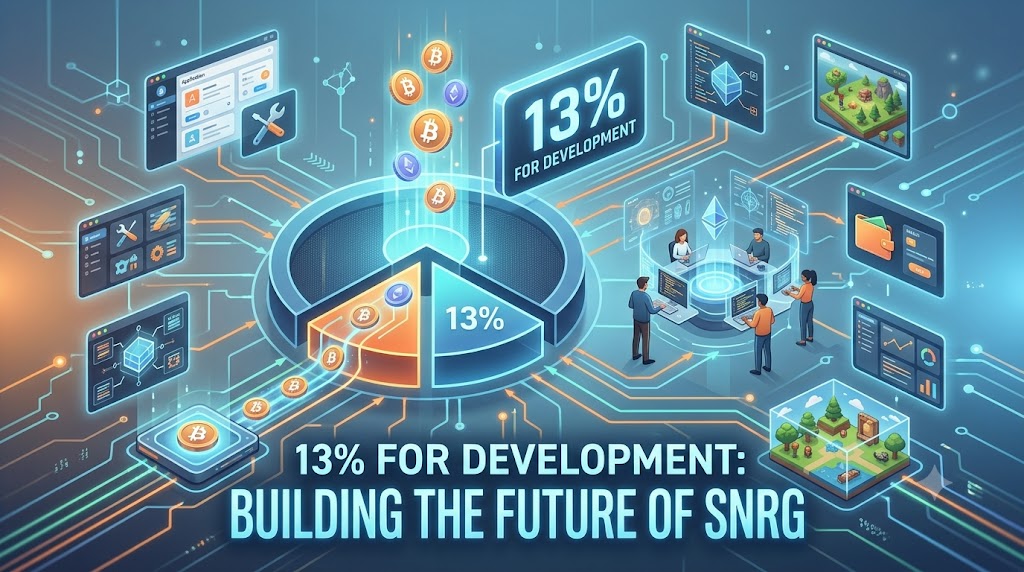
Blockchains become useful when developers build products and infrastructure on them.
Wallets.
Applications.
Developer tools.
Infrastructure.
Analytics.
Exchanges.
Games.
Financial products.
Identity systems.
Payment services.
Enterprise integrations.
And ideas nobody has invented yet.
Synergy Network’s tokenomics recognizes that distinction by allocating 13% of the fixed SNRG supply specifically to ecosystem and developer incentives.
That allocation is separate from the network’s marketing and growth budget.
The difference matters.
Attention Does Not Equal Adoption
Marketing can bring someone to a blockchain.
Only utility gives that person a reason to come back.
That means a serious Layer-1 network eventually has to convince developers that building on it is worth their time.
Developers have costs.
They need documentation.
Tooling.
Testing environments.
Libraries.
Examples.
Infrastructure.
Education.
Security support.
And sometimes direct economic incentives to undertake work that benefits an emerging ecosystem.
Synergy’s ecosystem allocation is designed to help finance that process.
Contribution Before Giveaways
The public tokenomics model describes developer-oriented distributions around measurable contribution.
That can include accepted code.
Reproducible bug reports.
Completed development milestones.
Security research.
Educational work.
Testing.
Infrastructure.
Open-source contributions.
Tools.
And deployed integrations.
This approach matters because there is a substantial difference between distributing coins to generate temporary activity and allocating resources to create lasting network capability.
Synergy’s model attempts to distinguish those categories.
Promotional activity belongs to growth.
Technical development belongs to the ecosystem.
Why Retail Holders Should Care About Developers
Imagine a smartphone with no applications.
The hardware could be excellent.
The operating system could be sophisticated.
But without useful software, most consumers would have little reason to own it.
Layer-1 blockchains face a similar reality.
A protocol can have advanced cryptography, an innovative consensus model, and sophisticated execution architecture.
Eventually, people still need things to do with it.
Developer activity converts infrastructure into products.
Products attract users.
Users create transactions.
Transactions create network activity.
Network activity can create demand for the native economic asset used throughout the ecosystem.
For Synergy Network, that asset is SNRG.
That does not mean developer grants automatically create SNRG demand.
It means the economic architecture recognizes one of the pathways through which real demand can potentially emerge.
Building an Ecosystem Instead of a Moment
Crypto markets can generate short bursts of attention with remarkable speed.
A viral post can create one.
A listing announcement can create one.
A price move can create one.
Building an ecosystem requires a longer time horizon.
It requires sustained work long after the excitement of a launch has passed.
Allocating 13% of SNRG to ecosystem and developer development creates resources specifically intended for that longer process.
For potential presale supporters, this offers another way to evaluate Synergy.
Do not simply ask whether the project can attract attention.
Ask whether it is creating the conditions necessary to build useful things.
That is the difference between marketing a coin and attempting to build an economy around a network.
Learn more about the Synergy developer ecosystem and SNRG presale at https://synergy-network.io/presale and https://synergy-network.io/whitepaper.